Selected engagements and applied work.

Client work is presented anonymised, in the same structure every engagement follows: the problem as the client had it, the approach taken, what the analysis found, and what changed.

Federal revenue authority

Tax-compliance and backduty-assessment infrastructure covering 33+ international operators

Problem

A federal revenue authority needed to assess and collect multiple tax types (withholding, value-added, corporate income, and excise) from more than 33 international operators in a regulated industry. Assessments were computed manually, treatment varied between officers, and historical underpayments (backduty) were effectively impossible to quantify at scale.

Approach

As sole technical lead, I designed and built the assessment infrastructure end to end: statutory tax logic encoded into software, per-operator assessment workflows, and a backduty engine that recomputes historical liability under the correct statutory treatment. Built on a modern web stack with full audit trails, because every figure had to survive challenge.

Findings

Encoding the statute exposed exactly where manual practice had diverged from it: inconsistent rate applications and unassessed periods that only became visible once every operator was computed under identical rules.

Outcome

A production system at handover stage with the authority, covering 33+ international operators, replacing manual assessment cycles with consistent, auditable, statute-faithful computation.

If your operation runs on rules nobody has encoded yet, this is what encoding them looks like.

A problem-solver — that is exactly what he is.
Chairman, State Board of Internal Revenue

Microfinance lender

An interpretable credit default model that credit officers can actually use

Problem

A microfinance lender was originating loans on officer judgment and policy rules. Default losses were absorbing margin, and the lender had repayment data it had never used quantitatively. Any model would need to be explainable, both to credit officers making decisions and to a regulator reviewing them.

Approach

I built an interpretable credit scoring model on the lender's loan-book data, deliberately favouring transparent methods over black-box accuracy. Every score decomposes into feature-level risk factors, and the documentation was written for two audiences: the credit team operating it and a regulator auditing it.

Findings

A small set of borrower characteristics carried most of the default signal, which meant the model could stay simple enough to explain in a credit committee while still ranking risk materially better than unaided judgment.

Outcome

A deployed scoring model with regulator-ready documentation, in use as a decision support tool at origination. A live demonstration version is public.

If you originate loans on judgment today, your repayment history is already the raw material for this.

His command of data and financial analysis comes through in the work — exactly what we needed as a lender.
Head of Risk & Finance, fintech lender

Audit engagement

Forensic review: finding financial leakage across reconciled accounts

Problem

An organisation suspected, but could not locate, financial leakage. Transactions spanned multiple accounts and systems, and conventional reconciliation kept closing the books without explaining where value was escaping.

Approach

I built the forensic review as an analytical pipeline rather than a manual sampling exercise: full-population multi-account reconciliation, exception reporting on every unmatched flow, and anomaly pattern analysis across periods to separate process noise from deliberate structure.

Findings

The exception population was small but not random: leakage concentrated in specific transaction types and timing patterns that sampling-based review had no realistic chance of catching.

Outcome

Identified leakage paths closed and an exception-reporting process the organisation now runs on every cycle, turning a one-off investigation into a standing control.

If the books close clean but the cash never quite matches, this is the review that finds out why.

A genuinely good data consultant. A real life-saver when the numbers had to be trusted.
Operator, financial services

E-commerce operator

Pricing and discount analysis: what the margin was actually buying

Problem

An e-commerce operator was discounting heavily to drive volume without knowing what the discounts cost in contribution margin, or whether price-sensitive segments were the ones responding.

Approach

I modelled price elasticity by product line, decomposed the profitability impact of historical discounting, and built a scenario matrix showing contribution margin under alternative pricing and discount policies, built for an operator to read, not a statistician.

Findings

A significant share of discount spend went to purchases that would have happened at full price. Elasticity varied enough across lines that a uniform discount policy was the most expensive possible version of the strategy.

Outcome

A repriced discount policy grounded in segment-level elasticity, and a sensitivity model the operator continues to use when planning promotional calendars.

If you discount to drive volume without knowing what it costs you in margin, this analysis answers that.

Client tools, live

Working implementations, all live. Open any of them and use it. Each one can be replicated and personalised to your business: your data, your decisions, your branding. The quantitative research instruments live under Research & Writing.

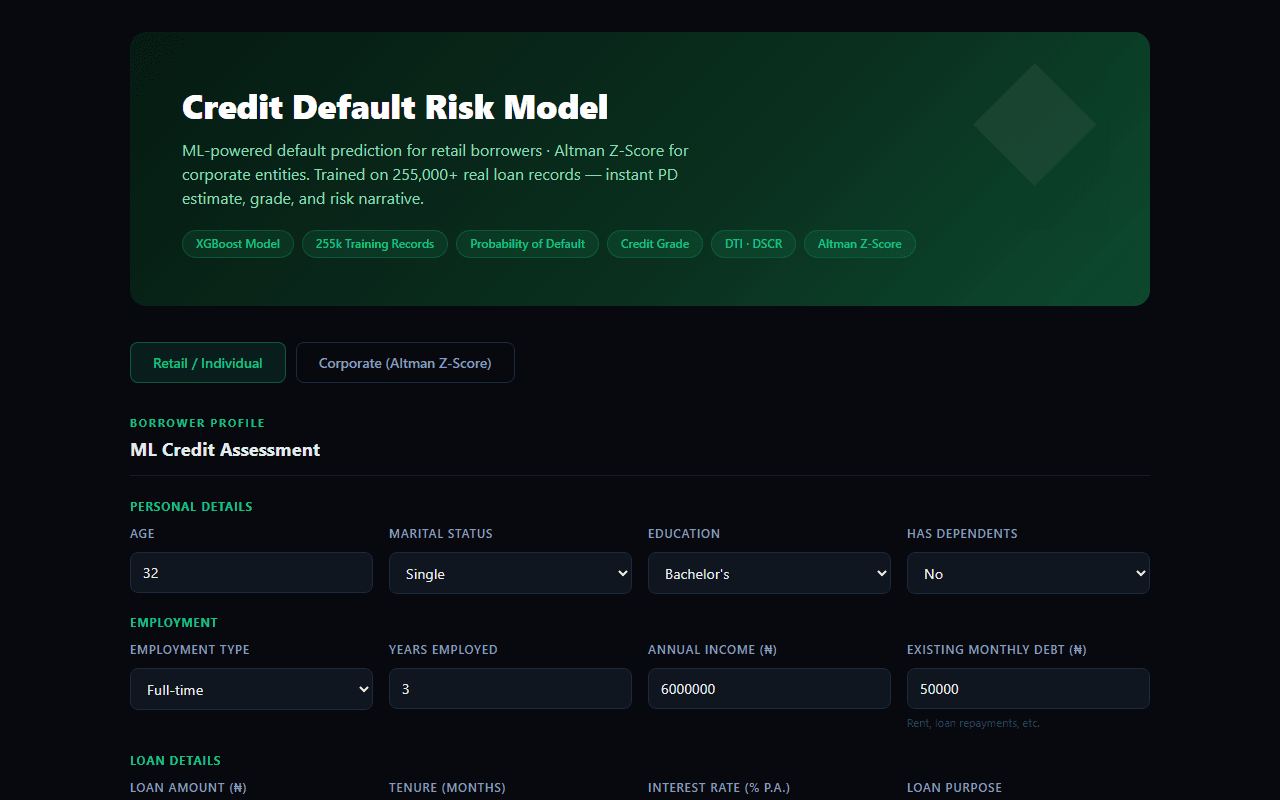
Credit Default Risk Model — live previewCredit Default Risk Model

Interpretable credit scoring with feature-level risk factors

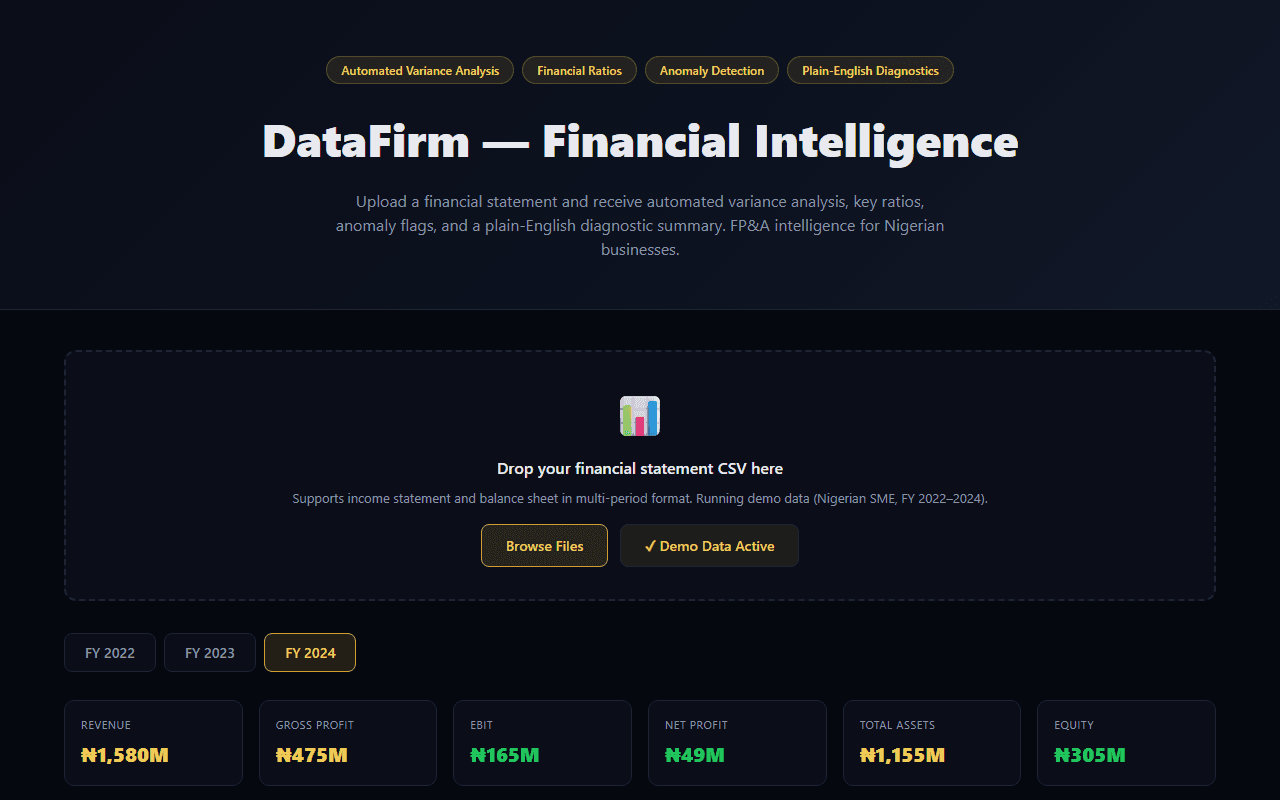
Financial Statement Diagnostic — live previewFinancial Statement Diagnostic

Automated variance analysis and ratio diagnostics from uploaded statements

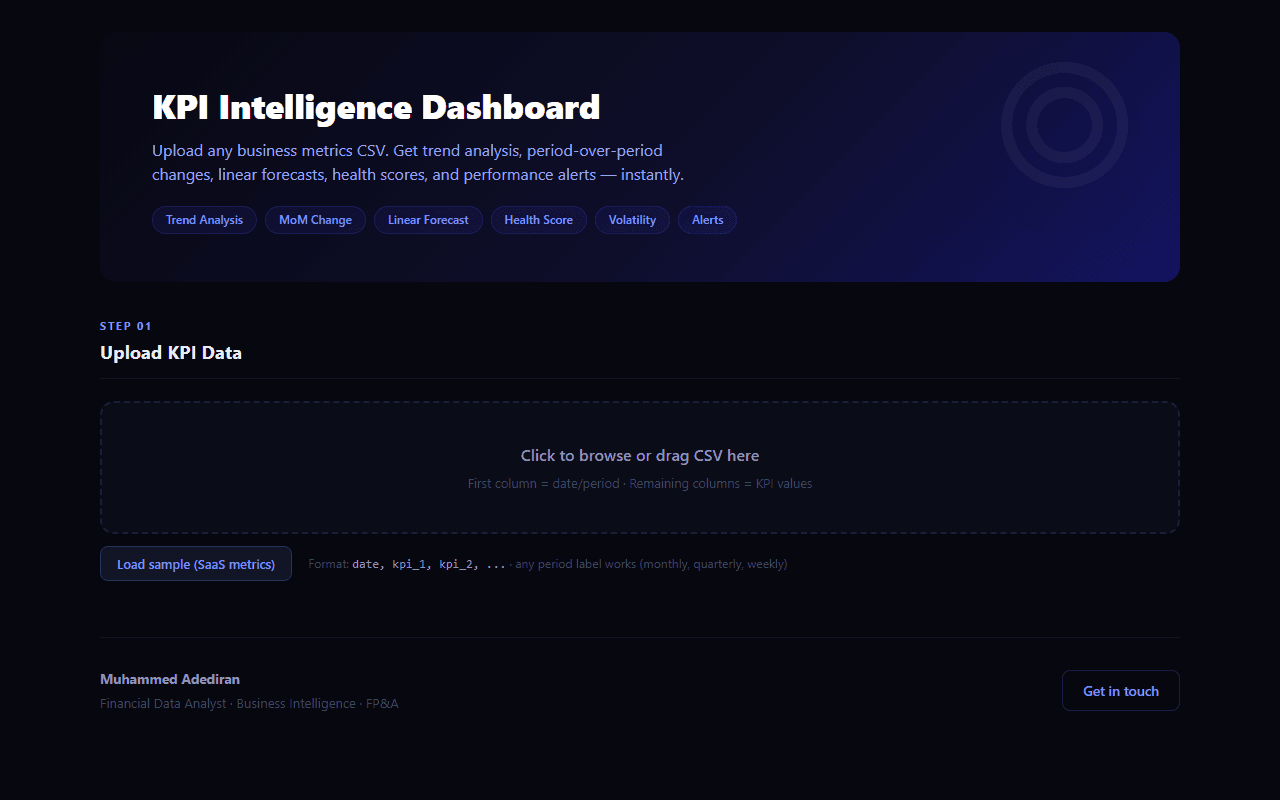
Financial KPI Intelligence — live previewFinancial KPI Intelligence

Variance decomposition and period-over-period reporting

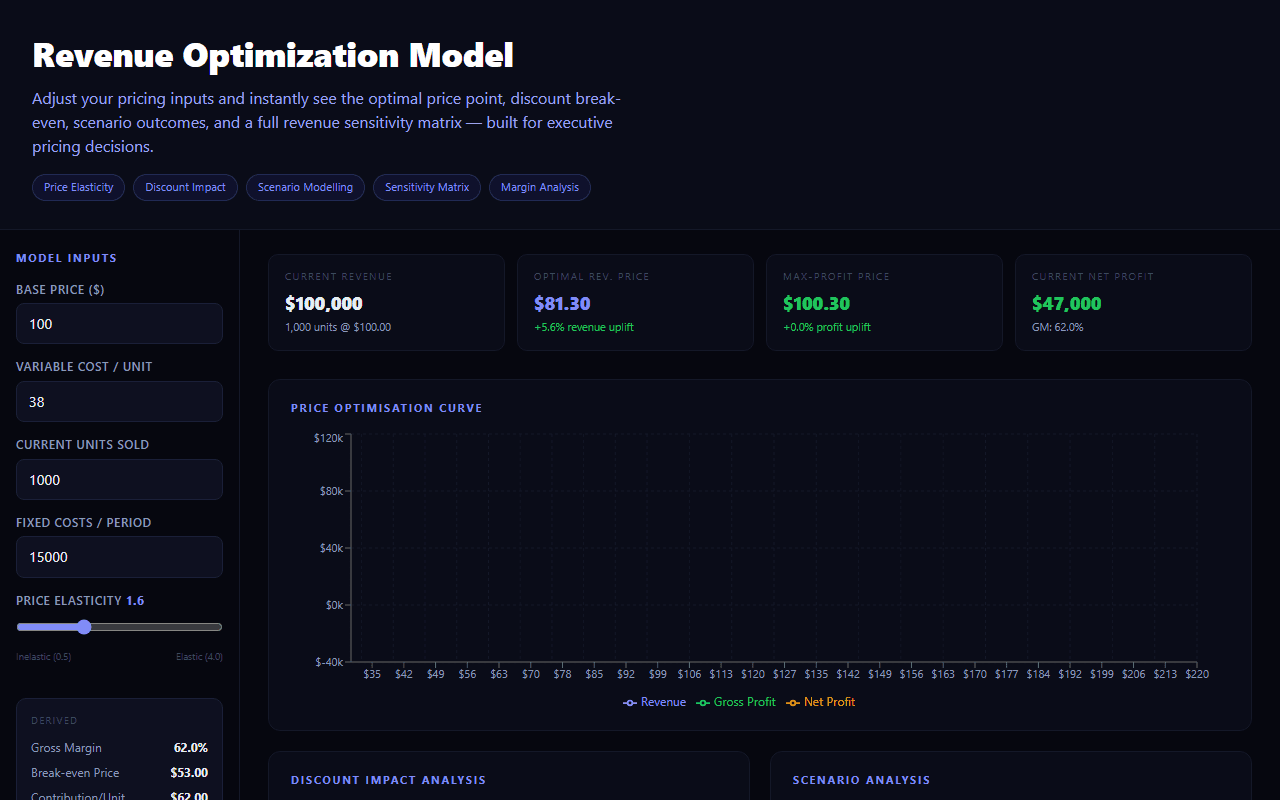
Revenue Optimization Model — live previewRevenue Optimization Model

Price elasticity and discount-impact scenario modelling

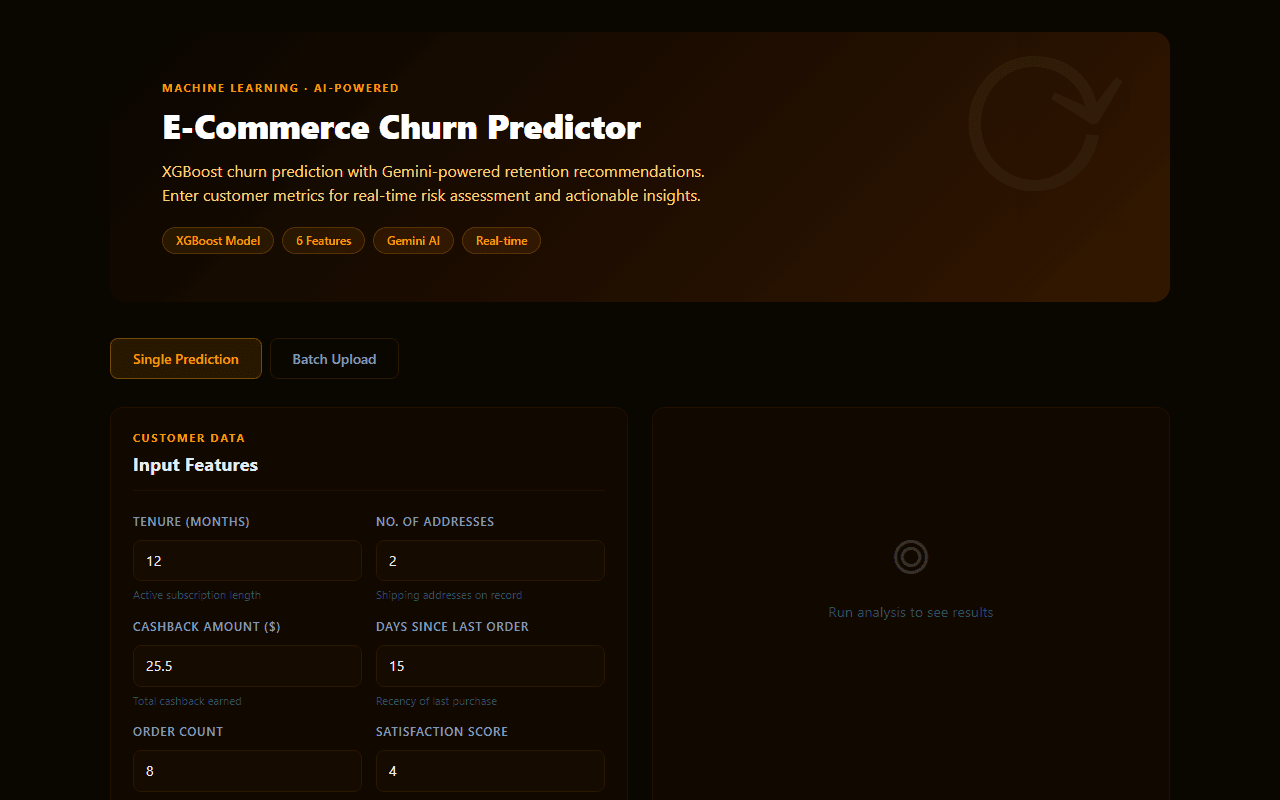
Churn & LTV Intelligence — live previewChurn & LTV Intelligence

Lifetime value and churn prediction with retention triggers

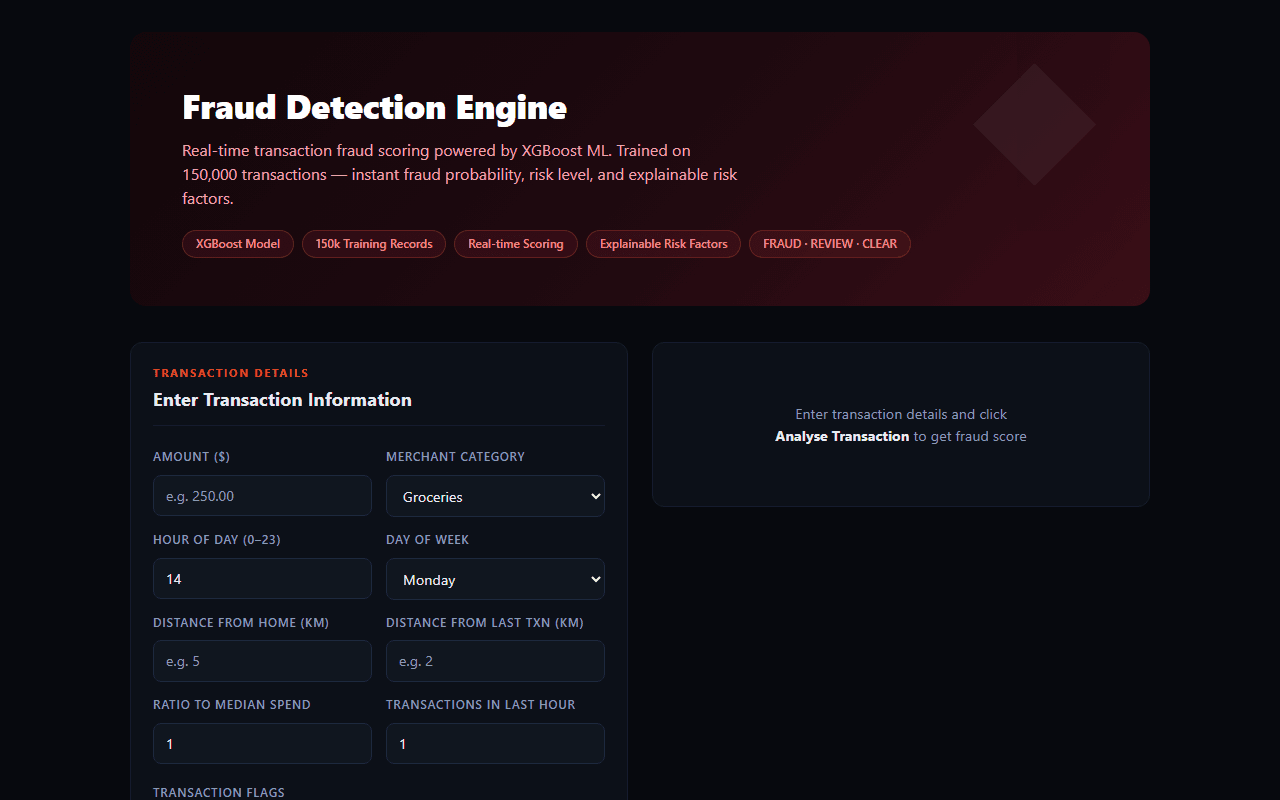
Fraud Detection Engine — live previewFraud Detection Engine

Isolation forest and autoencoder anomaly scoring

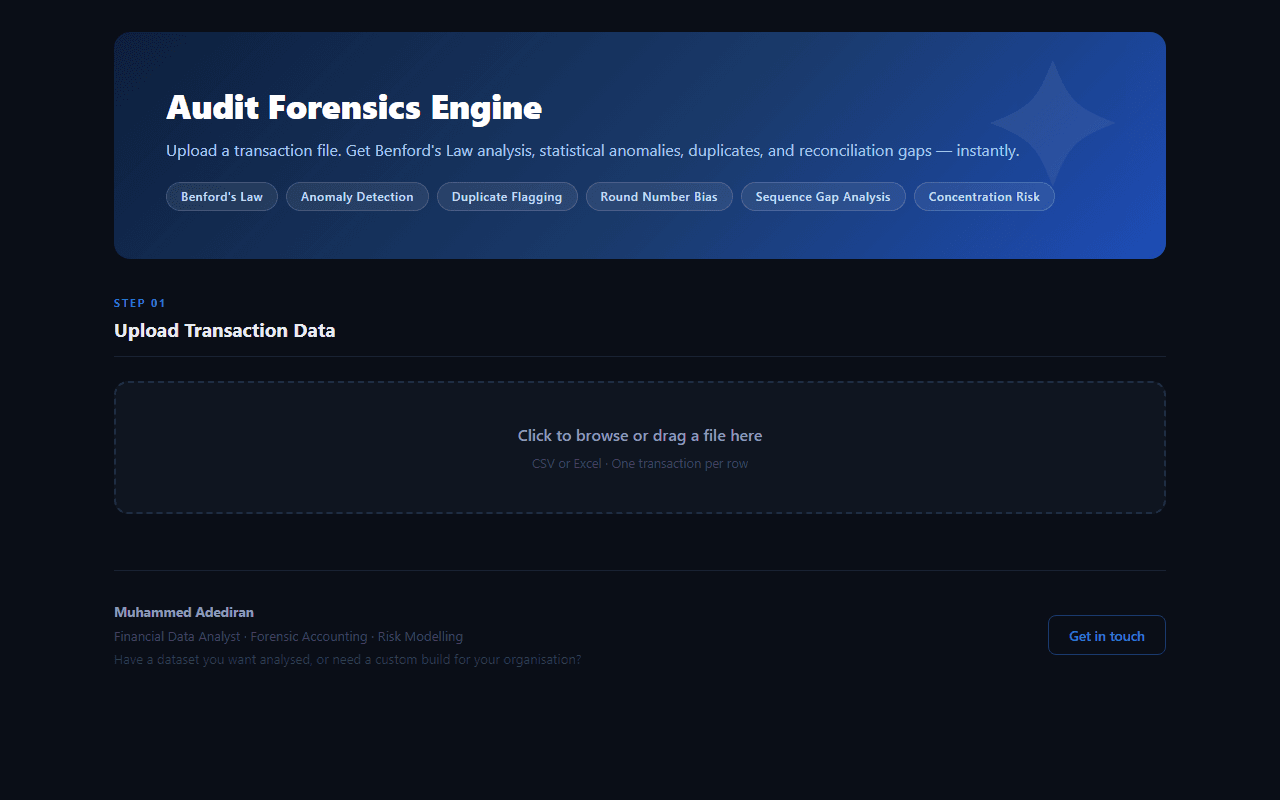
Audit Forensics Engine — live previewAudit Forensics Engine

Automated leak detection and reconciliation exception reporting

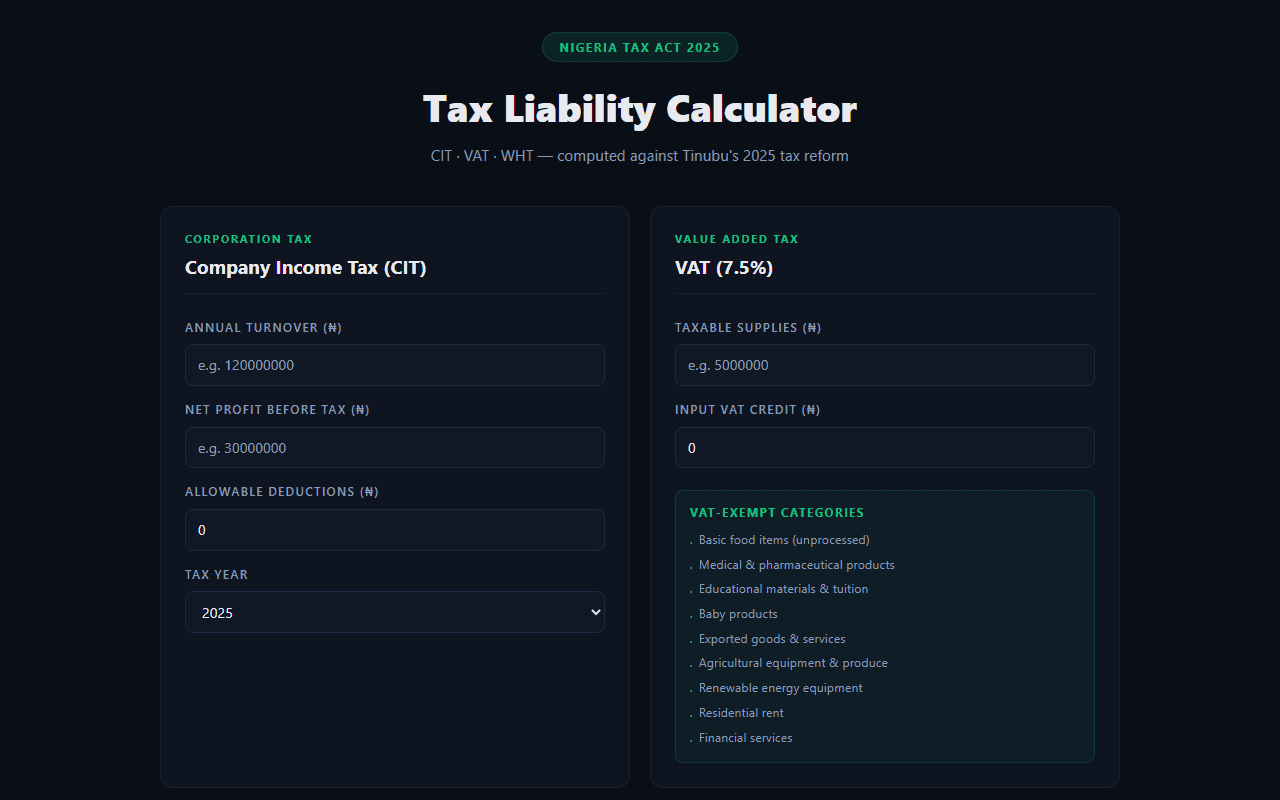
Business Tax Calculator — live previewBusiness Tax Calculator

Full corporate tax liability computation under 2025 reform law

If one of these problems looks like yours, the first step is a thirty-minute call.